A quartz crystal is a record of the space it grew in. One specimen is a clean six-sided prism standing free in a pocket; another is a crust of a thousand tiny points on a lump of limestone; a third looks like a small fir cone. Same mineral, same chemistry, wildly different silhouettes. That difference is habit, and it is one of the most useful things a collector can learn to read.
What Habit Actually Means
Quartz has a fixed internal geometry. Left to itself in quiet conditions it builds a hexagonal prism capped by rhombohedral faces, with prism faces meeting at 120 degrees. The form is that geometry; the habit is what the crystal actually ended up looking like. Long and needle-like, short and stubby, twinned, crusted, twisted, hollow-cheeked: all of it is quartz.
Habit is descriptive rather than a strict classification, which is why two experienced collectors might label the same specimen slightly differently. What matters is that habit is a visible summary of conditions at the moment of growth: how much space there was, how fast silica arrived, how many nucleation points existed, and whether growth was interrupted along the way.
Prismatic Crystals: Room to Grow
The classic quartz habit is a well-formed prism with a clean termination. It forms where a cavity stays open long enough for silica-bearing fluid to circulate and deposit slowly onto a small number of nuclei. Slow, steady supply favours fewer, larger crystals; the faces stay flat because nothing is crowding them.
Look at the base. A crystal still attached to matrix grew where it started. A doubly terminated crystal — points at both ends — was never attached at all, or was knocked loose early and continued growing while resting in soft clay at the bottom of a pocket. Alpine-style specimens from cleft deposits are often doubly terminated for exactly this reason, and they usually show the sharpest faces because nothing interfered with them.
Proportions carry a hint too. Needle-like prisms tend to grow quickly from strongly supersaturated fluids, while broader, stubby crystals often reflect hotter, slower conditions. Treat this as a tendency, not a rule: the same habit turns up in very different deposits, so locality evidence usually beats shape alone.
Drusy and Crusts: When Nucleation Wins
Drusy quartz is a surface covered in hundreds or thousands of tiny terminated crystals, each catching light on its own. It happens when nucleation is easy and space is not. A rough surface — a fossil, a limestone cavity wall, the inside of an agate nodule — offers countless starting points, and a brief pulse of silica-rich fluid coats all of them at once.
In practice, drusy tells you that the fluid was supersaturated enough to start crystals everywhere, but the episode was short or the cavity too tight for any of them to grow large. Sugar-like drusy on a sedimentary host rock and sparkling drusy inside a geode are the same story with different framing.
Sceptre Crystals: Growth in Two Acts
A sceptre is unmistakable once you have seen one: an earlier crystal forms the stem, and a later, wider generation of quartz caps it like the head of a ceremonial mace. That shape requires a change. Growth must have stopped — fluid cooled, chemistry shifted, or the pocket sealed — and then restarted under new conditions.
Because the two generations grew from different fluids, sceptres often show a colour break: a milky or smoky stem under an amethyst cap, or a clear head over a cloudy base. The neck between them is a natural weak point and the first place to check for a repair if you are buying. A reverse sceptre, where the later growth is narrower than the stem, points to a different sequence — often partial dissolution of the original crystal before renewed growth.
Cactus Quartz and Other Crowded Habits
Cactus quartz, sometimes called spirit quartz, takes the sceptre idea further. A core crystal — often amethyst or smoky — is covered in dozens of small, individually terminated points radiating outwards in every direction. It forms in near-surface cavities where silica deposition repeated in pulses, each pulse adding another layer of small crystals. The outer points are frequently paler than the core, their zoning recording those separate episodes.
Several other habits are worth recognising, and they all say something about restricted or interrupted growth:
- Gwindel: a flattened, twisted crystal from narrow Alpine fissures, where slow growth in tight space produced a stack that curls as it rises.
- Faden: a white thread of healed fracture running through the crystal, left behind as the host crack repeatedly opened and the crystal kept growing across it.
- Elestial and skeletal: stepped, hoppered or hollowed faces, typical of fast growth followed by partial dissolution.
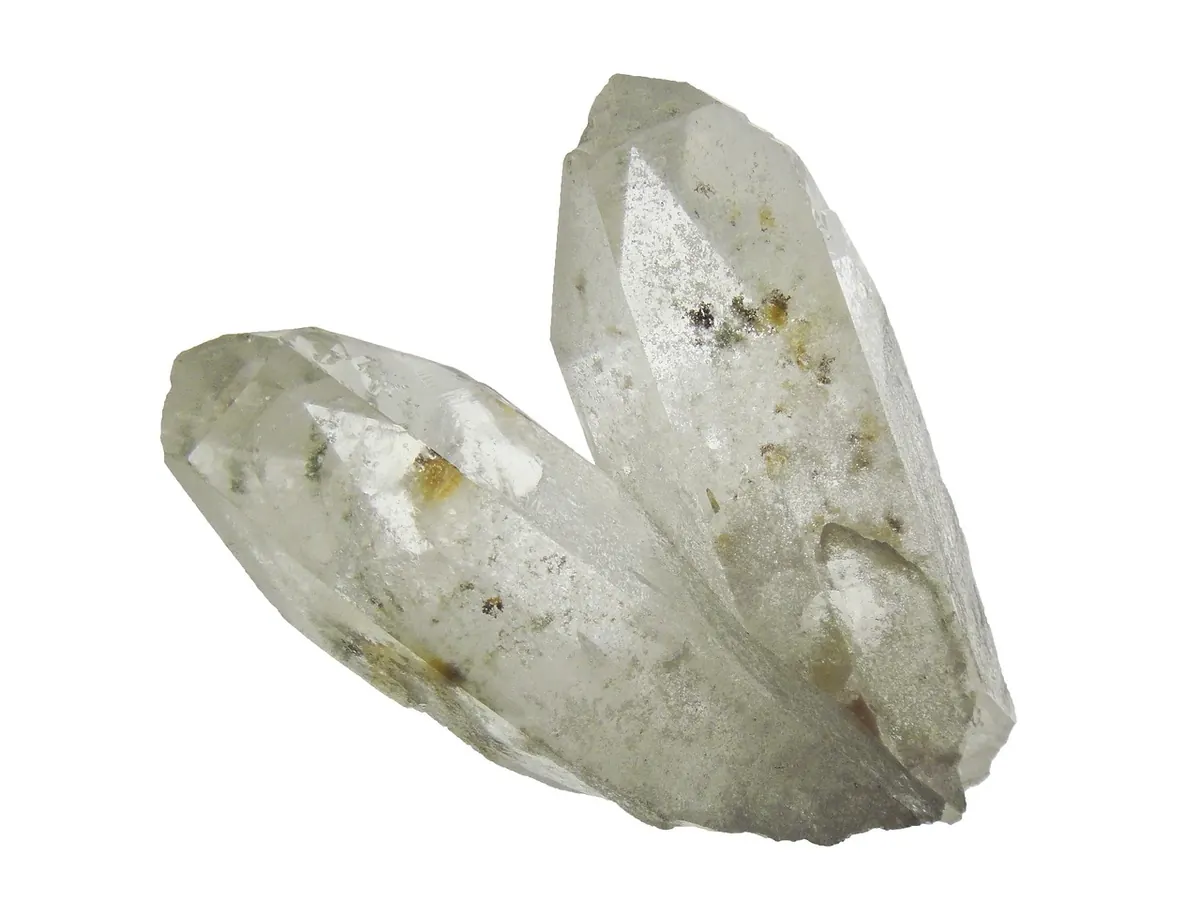
- Japan-law twin: two crystals joined at a shallow angle, giving a flattened, heart-like outline.
Reading the Clues: A Quick Checklist
- Check the base. Attached to matrix, it grew in place. Cleanly terminated at both ends, it grew free.
- Count the crystals. A few large ones mean few nucleation points and generous space; thousands of equal-sized points mean the opposite.
- Look for breaks in growth — colour zoning, phantom outlines, a sceptre neck, milky turning to clear.
- Inspect for dissolution. Frosted, rounded, pitted or hoppered faces mean the fluid later became undersaturated and started eating the crystal back.
- Judge the proportions against other specimens from the same locality, not against a photo in a book.
Practical Notes for the Field and the Cabinet
Habit reads best in silhouette. Photograph specimens against a plain background with a scale, from at least two angles, and note the locality straight away — a habit that looks unusual in isolation is often perfectly ordinary for a particular district. Local mineral clubs and museum reference collections are excellent for building that mental library.
Handle sceptre necks and cactus points carefully; both are fragile by design, and the neck is where any old repair will show. Store drusy and heavily crystallised pieces so the points rest on foam rather than each other. And keep in mind that habit narrows the possibilities without closing them: it tells you what kind of space and fluid history a crystal experienced, not the name of the mine it came from.
Photo: uhi_noko812 / Pixabay