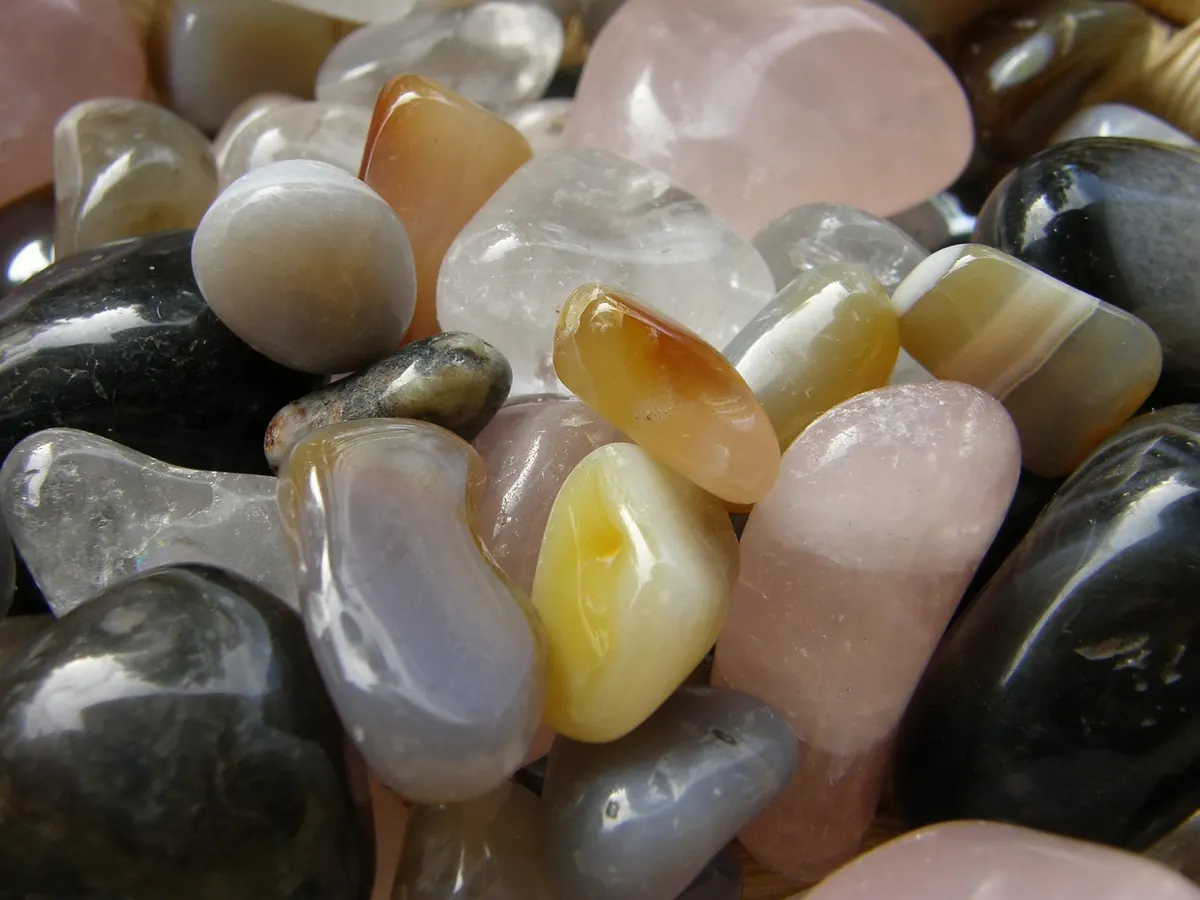
Hold a piece of rock crystal up to the light and it looks like frozen water. Cut and polish the very same mineral — silicon dioxide, nothing more — and you can end up with deep purple, honey gold, or a smoky brown so dark it reads as black. Amethyst, citrine and smoky quartz are not three different stones. They are one stone that has picked up a few stray atoms and then sat in the ground for a very long time.
Understanding how that works is genuinely useful. It tells you why some amethyst fades on a windowsill, why so much citrine on the market looks nothing like the natural thing, and how to judge a stone in a shop without any lab equipment.
Pure quartz has no colour at all
Quartz is built from silicon and oxygen arranged in a rigid three-dimensional framework. When that framework is perfect, the stone is colourless and transparent — rock crystal. It absorbs nothing in the visible range, so every wavelength passes straight through and reaches your eye unchanged.
Which means any colour in quartz is an accident of geology. Two things have to go wrong, in a very specific way, and for the colours we care about here, both usually happen together. One is chemistry. The other is radiation.
Stray atoms and a long, slow dose of radiation
Start with the chemistry. As quartz grows from hot, mineral-rich water, other elements are floating around in that solution. Aluminium is the most common troublemaker, followed by iron and titanium, with lithium and hydrogen turning up too. These atoms are present at parts per million — far too little to see — but a few of them manage to take silicon's place in the lattice.
The problem is that they do not fit neatly. Aluminium has a different charge from silicon, and iron in its common form does as well. Every substitution leaves the structure slightly out of balance, with a missing bond or a nearby hydrogen atom propping things up. These imbalances are called lattice defects, and they are the raw material for colour.
The second ingredient is radiation. Rocks surrounding a quartz vein often contain small amounts of potassium, uranium and thorium, all of which decay slowly and emit alpha, beta and gamma radiation. The levels are low, but geological time is generous. Over hundreds of thousands of years, a crystal can absorb a substantial dose — enough to knock electrons loose from their usual positions and send them wandering through the lattice.
The colour is a defect, not a pigment
Here is the idea that makes everything else click. The colour in amethyst, citrine and smoky quartz is not a pigment sitting inside the stone. It is a structural defect that absorbs certain wavelengths of light and lets the rest through. Whatever is left over is the colour you see.
Gemmologists call these colour centres. An electron gets trapped at a defect site — commonly next to an aluminium or iron atom — and that arrangement absorbs light in a particular part of the spectrum. Change the arrangement and you change the colour. Remove the trapped electron and the colour disappears entirely, even though the chemistry of the stone has not altered at all.
That last point explains a great deal of what you see in the trade. Heating, and prolonged exposure to ultraviolet light, can move electrons in and out of these traps. Colour can therefore be created, shifted or destroyed without the stone gaining or losing a single atom.
Amethyst: iron plus radiation
Amethyst is the classic case. Iron atoms sit in place of silicon, in their oxidised form, and natural gamma radiation then strips away an electron from that site. The resulting defect absorbs yellow-green light strongly and lets purple through. No iron, no purple; no radiation, no purple either.
This is why amethyst so often shows colour zoning — bands, patches or an hourglass pattern where purple is deeper in some growth sectors and pale in others. Different crystal faces take up iron at different rates as the crystal grows, so the colour ends up unevenly distributed. Good specimens often have a darker tip and paler base.
Amethyst is also famously light-sensitive. Leave a piece in strong direct sunlight for months and the colour will noticeably soften as trapped electrons are released. Heat it more aggressively — a few hundred degrees Celsius — and the purple goes altogether, usually turning yellow-orange, then greenish, then colourless.
Citrine: iron rearranged, and the heat-treated question
Citrine shares the same basic ingredient list as amethyst: iron in the lattice, plus a history of radiation and oxidation. The difference lies in how the electrons are arranged around those iron sites, which shifts the absorption from the purple part of the spectrum into the yellow and orange.
Natural citrine is genuinely uncommon. Most citrine sold today started life as amethyst and was heated, either in a furnace or in the ground by nearby volcanic activity. Both routes give you a yellow-to-orange quartz, but they do not look the same:
- Natural citrine tends to be a pale lemon or soft golden yellow, sometimes with a smoky brown undertone. Colour is usually even, or fades gently from tip to base.
- Heated amethyst often comes out a stronger orange-red, with a distinct white or milky zone at the base and sharp boundaries between coloured and colourless areas.
- Heated smoky quartz can also produce a yellowish-brown material that is sold as citrine.
None of this makes heated citrine fake — it is still quartz, and the colour is stable. But it should be described honestly, and a strong orange stone with a white base is usually a heat-treated one.
Smoky quartz: aluminium and the surrounding rock
Smoky quartz usually gets its colour from aluminium rather than iron. An aluminium atom replaces silicon, charge balance is maintained by a nearby hydrogen atom, and radiation then removes an electron from an adjacent oxygen. The resulting defect absorbs broadly across the visible range, which is why smoky quartz looks grey, brown or almost black rather than a clear single hue.
How dark it goes depends largely on how much radiation the crystal received. Quartz growing near uranium- or thorium-bearing minerals can end up very dark indeed; some material from the Cairngorm Mountains in Scotland, long prized for jewellery, is a fine smoky brown. Radiation is not always a one-way process — heating a smoky quartz gently in a laboratory can lighten it dramatically, and stronger heat removes the colour completely.
Other quartz colours follow the same rules
Once you know the pattern, the rest of the family falls into place:
- Rose quartz is pink, usually cloudy, and linked to trace titanium and iron together with microscopic fibrous inclusions. It fades in strong sunlight.
- Milky quartz is white because of countless tiny fluid inclusions scattering light — chemistry plays little part.
- Prasiolite is green, most often produced by heating amethyst to higher temperatures; natural material is rare.
- Ametrine shows purple and yellow in one crystal, because different zones took up iron differently and had different radiation histories.
What this means in practice
A few habits worth adopting if you own or buy coloured quartz.
Treat amethyst and smoky quartz as light-sensitive. A shelf away from a south-facing window is fine; months of direct summer sun is not. If a piece does fade, the change is generally not reversible at home.
Never test colour with an oven, a blowtorch or a campfire. Heat changes quartz permanently, can crack a stone along existing fractures, and destroys value rather than confirming anything.
When buying citrine, ask directly whether it is natural or heat-treated. A seller who knows their stock will tell you. For anything expensive, buy from someone who states treatment in writing, and remember that a gemmologist can identify most treatments with laboratory equipment.
For cleaning, warm water with a little mild washing-up liquid and a soft brush is safe for quartz. Ultrasonic cleaners are usually fine for solid, unfractured stones, but avoid them for heavily cracked or fracture-filled material. Quartz is hard and tough, but it dislikes sudden temperature changes and knocks along cleavage-free but brittle edges.
Photo: kacandybln / Pixabay